
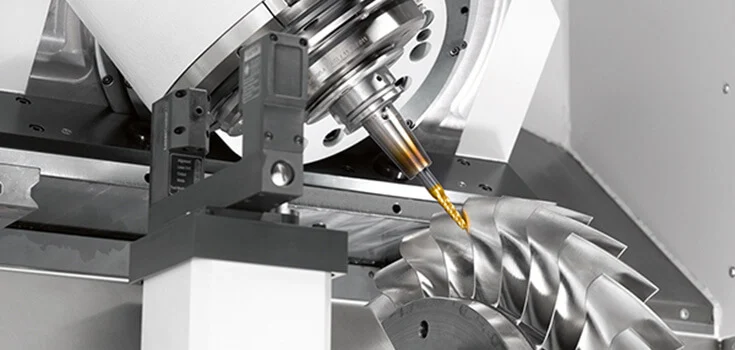
Achieving ultra-precise radius blending within asymmetric turbine hub pockets has become a defining benchmark for manufacturers supplying components to aerospace propulsion, advanced power-generation systems, and high-speed turbomachinery. As turbine architectures evolve toward more compact geometries, higher load densities, and aggressive efficiency targets, the dimensional integrity of hub pocket transitions increasingly dictates structural reliability and aerodynamic performance. These pockets often feature multi-axis curvature shifts, compound radii, and asymmetries introduced by weight-reduction strategies or flow-path optimization. Traditional machining methods struggle to maintain uniform material engagement, consistent scallop height, and controlled surface transitions across such irregular profiles. This is where advanced CNC radius-blending strategies—supported by real-time machine feedback, adaptive toolpath algorithms, and high-stability cutting platforms—deliver transformative advantages. By ensuring that every micro-radius aligns with stress-flow predictions and fatigue boundary requirements, these strategies elevate both component longevity and turbine output.
Modern CNC systems offer capabilities that far exceed legacy 3-axis interpolation, especially when machining asymmetric turbine hub pockets characterized by unpredictable radial transitions. With today’s high-speed control loops, spline-based motion planning, and dynamic tool orientation adjustments, machinists can achieve sub-micron accuracy across complex blend radii. Instead of relying on static cutter compensation or manual verification steps, advanced CAM engines generate engagement-aware toolpaths that automatically adapt to localized curvature changes. This results in predictable cutting pressures, smoother directional transitions, and reduction of stress risers caused by uneven blending. Because asymmetric pockets rarely allow mirrored toolpath replication, machines must continuously recalculate tool engagement zones while preserving precise tangency between surfaces. Ultra-precise blending strategies address this challenge using multi-axis morphing, curvature-driven stepovers, and contact-point optimization to maintain geometrical fidelity even as the pocket’s profile varies across its depth and width.
One of the most significant breakthroughs in radius-blending performance comes from integrating material-removal simulation with physics-based tool engagement modeling. Turbine hub pockets demand a delicate balance between efficient machining and the structural performance of final contours. Excessive cutting forces during blending can distort workholding fixtures, induce micro-vibrations, or lead to tolerance drift—especially when asymmetrical pockets create inconsistent support surfaces. Modern CNC strategies therefore rely on predictive engagement control, ensuring that every tool engagement angle, chip thickness, and radial immersion is optimized for stability. By simulating cutter load ahead of real machining, manufacturers can refine stepdowns, adjust feedrates, and modify tool approach vectors before any metal is removed. This reduces scrap, eliminates trial-and-error programming, and ensures the final radii conform precisely to aerodynamic and stress modeling requirements. Additionally, the use of barrel cutters, lens tools, and high-feed radius inserts enables wider engagement surfaces at lower scallop heights, reducing the total number of passes without sacrificing precision.
Surface integrity plays a critical role in the performance of turbine hub pockets, and this is where ultra-precise CNC radius blending proves essential. Asymmetric pockets often experience uneven stress distribution under thermal and centrifugal loading, making consistent surface transitions vital for preventing crack propagation or local fatigue concentrations. Advanced toolpath smoothing algorithms—such as NURBS interpolation, quintic trajectory blending, and corner-deviation suppression—contribute to achieving mirror-quality finishes even at high machining speeds. By keeping acceleration values stable and minimizing jerk-induced tool chatter, these strategies maintain uniform residual-stress patterns across the blended regions. Furthermore, the use of in-process metrology systems allows machinists to inspect key radii, chamfer transitions, and wall intersections without removing the part from the machine. Probing routines, scanning-capable touch sensors, and on-machine optical systems capture minute deviations, enabling automatic toolpath compensation for the final blending passes. The result is a surface profile that meets or exceeds aerospace-grade smoothness while conforming perfectly to engineered stress contours.
Another driver of excellence in radius blending is the evolution of adaptive multi-axis motion control. Turbine hub pockets with asymmetrical features often introduce steep internal walls, hard-to-reach corners, and blend zones that shift orientation along the part’s rotation. With adaptive five-axis control, the machine continuously recalculates its tool vector to maintain optimal contact between the cutter and the workpiece. This reduces the likelihood of gouging, eliminates flat spots at curvature transitions, and preserves a fully blended geometry across the entire surface. Machine learning–enhanced feedrate optimization tools further refine the results by automatically scaling cutting parameters based on real-time spindle load, vibration signatures, and positional feedback. As the cutter navigates the asymmetric pocket, the CNC system adjusts its motion to maintain consistent energy input, ensuring the blended radii remain smooth and dimensionally stable. Combined with thermal compensation technology and linear-scale feedback, these innovations ensure that radius blending maintains absolute precision even during long machining cycles or under varying thermal conditions.
In the broader context of turbine manufacturing, implementing ultra-precise CNC radius-blending strategies for asymmetric hub pockets reflects a shift toward digitally connected, precision-driven machining environments. Manufacturers who adopt these techniques benefit from reduced rework, shorter cycle times, improved material efficiency, and more predictable part performance. As turbines continue to evolve toward lighter, more efficient architectures, the importance of precise blended geometries grows proportionally. With enhanced control over surface curvature, load distribution, and micro-radius uniformity, modern CNC machining empowers engineers to push performance boundaries while maintaining uncompromising safety margins. By uniting advanced toolpath algorithms, real-time engagement control, precision metrology, and adaptive multi-axis motion planning, today’s ultra-precise radius-blending strategies set a new standard for machining asymmetric turbine hub pockets—delivering consistent, high-performance results that meet the demands of next-generation propulsion and power systems.