
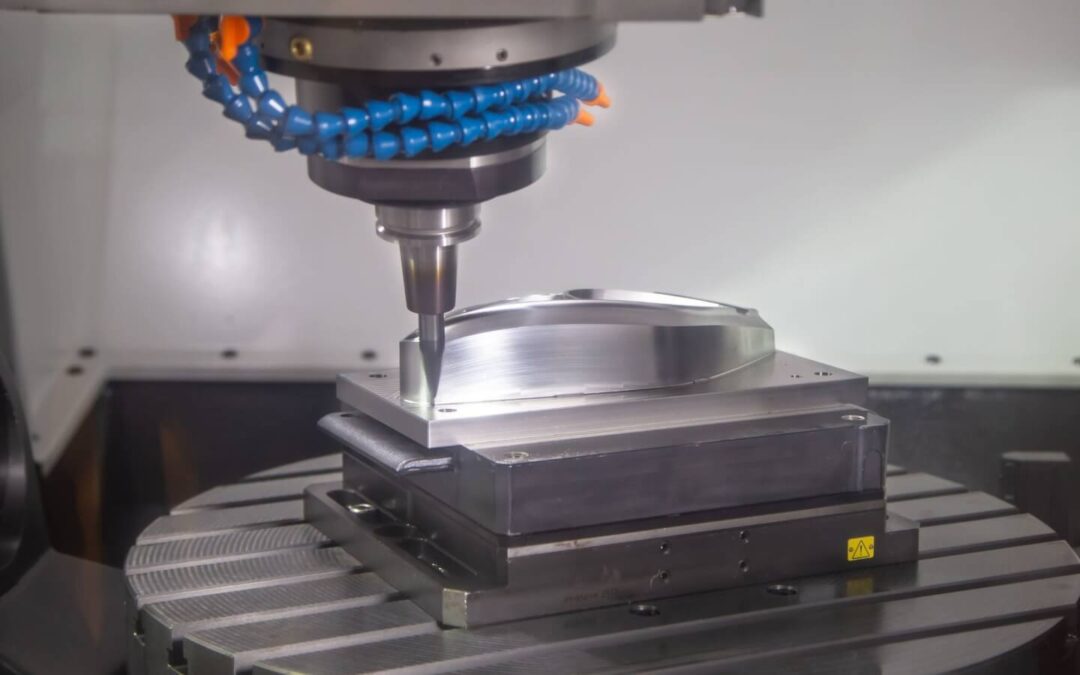
CNC high-precision pocket milling has become a cornerstone of advanced aerospace machining, particularly for manufacturing multi-depth turbine disk cooling slots that serve as essential thermal management features in modern turbomachinery. These cooling slots are engineered to channel compressed air through the turbine disk, stabilizing temperature distribution and preventing material degradation during high-temperature operation. As turbine inlet temperatures continue to rise to improve engine efficiency and thrust capacity, the need for precisely machined, multi-depth cooling features becomes even more critical. Conventional milling processes struggle to achieve the necessary dimensional consistency, smooth transitions, and structural integrity required for these complex geometries. CNC high-precision pocket milling solves these challenges by combining advanced multi-axis interpolation, controlled stepdowns, customized toolpath programming, and high-performance tooling suited for superalloys. The result is a machining approach capable of generating cooling pockets with micron-level depth accuracy, uniform sidewall surfaces, and repeatable thermal-flow characteristics that directly influence engine reliability and fuel efficiency. With increasingly sophisticated turbine architectures demanding more intricate cooling strategies, the role of precision pocket milling continues to expand across both OEM and MRO sectors.
One of the greatest challenges in machining multi-depth cooling slots lies in controlling geometry transitions between different depth levels while maintaining uninterrupted aerodynamic flow and structural cohesion within the disk. These features often require tapering sections, varying channel widths, and precise floor-to-wall transitions that must align perfectly with the cooling airflow design created by the engineering team. High-precision CNC pocket milling enables this by allowing the tool to move fluidly through complex geometries using adaptive toolpaths that adjust stepover, tool angle, and engagement depth based on real-time machine feedback. Modern CAM systems generate toolpaths that maintain constant material engagement, preventing sudden spikes in cutting force that can deflect tools or distort thin regions of the disk. Multi-depth pockets benefit particularly from trochoidal and high-efficiency milling (HEM) strategies, which distribute thermal load uniformly while enabling deeper cuts with minimal risk of overheating. These toolpath patterns also help maintain consistent chip evacuation—an essential factor when machining Inconel, Waspaloy, or other heat-resistant alloys commonly used in turbine disk production. The ability to maintain geometric precision through multi-depth structures ensures that cooling airflow remains stable, predictable, and optimized for maximum thermal protection during engine operation.
At the heart of high-precision pocket milling is the use of advanced multi-axis CNC equipment capable of manipulating both the tool and the workpiece with extreme accuracy. Multi-depth cooling slots require precise angular alignment, especially when pockets are machined along curved surfaces or complex radial paths. Five-axis machining platforms allow the cutter to orient itself optimally for each region of the pocket, minimizing tool deflection and maximizing surface finish quality. By tilting the tool to maintain a perpendicular or optimized engagement angle, manufacturers can achieve tight dimensional tolerances even in deep radial pockets or curved internal channels. Additionally, synchronized machine motion helps eliminate tool chatter and vibration—a key factor in achieving the ultra-smooth surfaces required for aerodynamic stability. Many modern aerospace machining centers incorporate active vibration control, feedback sensors, and real-time adaptive adjustments that fine-tune cutting conditions during pocket milling. This capability not only improves the quality of multi-depth cooling features but also extends tool life and reduces scrap rates. The overall result is a highly stable machining environment where precise depth layering, uniform rib thickness, and flawless channel continuity can be consistently achieved even under the most demanding geometrical conditions.
Tooling and toolpath interaction play an equally significant role in achieving high-precision results for multi-depth turbine disk cooling slots. Because turbine disks are commonly manufactured from highly resilient superalloys, the cutting tools used must be engineered for durability, heat resistance, and rigidity. Micro-grain carbide end mills, reinforced neck tools, and coated cutters with AlTiN, TiAlN, or PVD nano-composite layers have become essential for maintaining sharpness during extended cutting cycles. For deep or narrow pockets, reduced neck or extended reach cutters ensure better access while minimizing tool vibration. Barrel cutters, lens cutters, and circle-segment tools further enhance finishing efficiency by maximizing surface contact with fewer passes, resulting in smoother channel surfaces and tighter depth tolerances. The integration of advanced toolpath techniques such as constant-Z finishing, variable stepover smoothing, and adaptive clearing ensures consistent cutting loads and stable thermal conditions. Tool wear monitoring systems detect cutting edge degradation early, allowing the machine to compensate automatically or initiate tool replacement before accuracy is compromised. This combination of high-performance tooling and adaptive toolpath optimization ensures that multi-depth turbine cooling slots maintain the required dimensional integrity, smoothness, and mechanical strength needed for extreme engine environments.
Thermal management during machining is another core component of achieving high-precision results in multi-depth cooling slot production. The superalloys used in turbine disk manufacturing are extremely sensitive to heat buildup, with low thermal conductivity that causes cutting temperatures to rise rapidly. Excessive heat not only dulls tools but also introduces microstructural changes that compromise disk performance and fatigue life. To counter this, high-pressure coolant delivery systems are utilized to flush chips, maintain a stable cutting zone temperature, and prevent work-hardening. Through-tool coolant systems direct fluid precisely where it is needed, particularly in deep pocket regions where chip evacuation is challenging. In some advanced applications, cryogenic machining using liquid nitrogen enhances thermal stability and reduces residual stress in the pocketed surfaces. Thermal modelling software further aids process planning by predicting heat distribution throughout the workpiece during pocket milling, allowing manufacturers to refine toolpaths and machining parameters before production. With strict aerospace quality standards requiring uniform thermal properties across all cooling features, precise thermal control during machining becomes just as important as mechanical accuracy.
As turbine disk design continues evolving to support higher operating pressures, more efficient cooling architectures, and lighter component structures, the role of CNC high-precision pocket milling will grow even more critical. Future turbines will incorporate multi-depth cooling slots with more complex shapes, integrated micro-channels, hybrid additive-subtractive features, and tailored aerodynamic contours designed for specific airflow patterns. This shift demands even greater machining control, tighter tolerances, and higher repeatability from manufacturers. Digital twin simulations, AI-driven optimization, automated toolpath correction, and real-time adaptive machining will become standard across the industry as companies seek to push the boundaries of precision manufacturing. Multi-depth cooling slot production will increasingly rely on hybrid processes where additive manufacturing produces near-net internal channel structures before CNC finishing refines them to exact specifications. Manufacturers who invest in the latest CNC technologies, process monitoring systems, thermal modelling, and advanced tooling will be best positioned to deliver turbine disks that meet the demanding performance expectations of tomorrow’s aerospace engines. Ultimately, high-precision pocket milling is not merely a machining technique but a mission-critical capability that ensures enhanced thermal efficiency, structural reliability, and long-term durability across the entire turbomachinery system.