
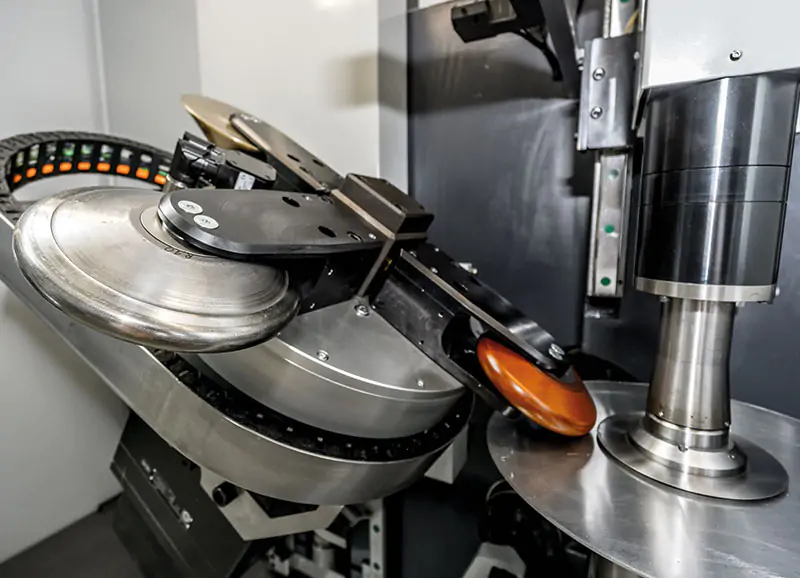
CNC controlled tool engagement has become an essential machining strategy for producing variable-radius turbine rim recesses that meet the increasingly demanding performance standards of aerospace and industrial turbomachinery. These recesses play a critical role in balancing aerodynamic flow, accommodating thermal expansion, and supporting blade-root interfaces within both compressor and turbine sections. As turbine designs evolve toward lighter structures, higher pressure ratios, and more efficient heat management, manufacturers must machine complex recess geometries with extreme consistency and minimal structural deviation. Variable-radius recesses are especially challenging because they require smooth, continuous curvature transitions along surfaces that may shift in radius, depth, and angle over tight tolerances. Traditional milling strategies often lead to inconsistent tool loading, chatter, surface waviness, or thermal hotspots that compromise dimensional accuracy. CNC controlled tool engagement eliminates these uncertainties by regulating cutting forces, maintaining constant chip loads, and optimizing toolpath geometry for each curvature segment. This precise engagement strategy ensures that every recess is machined with high fidelity to the engineering model, delivering the structural reliability, fatigue resistance, and flow efficiency required for top-performing turbine assemblies.
The complexity of variable-radius rim recesses demands a machining approach that adapts dynamically to shifting tool engagement zones. Unlike uniform-radius cuts, variable-radius designs require the cutting tool to follow continuously changing curvature transitions that influence how the tool contacts the material. Without controlled engagement, the tool may experience fluctuating radial loads, resulting in tool deflection, accelerated wear, or surface deformation. Modern CNC systems counteract these risks by using engagement algorithms that keep cutting forces constant along the entire toolpath. They regulate feed rate, tilt angle, stepover, and tool orientation to ensure the cutter maintains an ideal level of contact with the material regardless of shape variation. This controlled approach provides smoother cutting action and minimizes friction at curvature inflection points, preventing gouging or dwell marks that can degrade surface integrity. High-performance CAM software further enhances the process by simulating engagement patterns before machining begins, allowing engineers to fine-tune toolpaths to achieve balanced cutting loads across every radius transition. The result is a uniform recess profile that maintains structural harmony throughout the turbine rim, supporting both aerodynamic optimization and mechanical load distribution.
Another crucial advantage of controlled tool engagement is improved thermal consistency when machining advanced turbine alloys. Modern turbine rims are commonly produced from nickel-based superalloys such as Inconel, René alloys, or titanium-based materials, all known for their extreme heat resistance and challenging machinability. These materials retain heat, harden quickly under tool pressure, and generate abrasive chips that can damage cutting edges. Controlled tool engagement helps manage these thermal challenges by regulating the tool’s interaction with the material in a way that minimizes heat concentration. Instead of allowing uncontrolled force spikes to generate excess friction and thermal buildup, the machining strategy ensures steady cutting loads that distribute heat more evenly across the tool and workpiece. Combined with advanced high-pressure coolant delivery and through-tool cooling systems, this approach prevents thermal deformation of the rim recesses and maintains microstructural stability in the heat-affected zones. Thermal stability is critical for turbine rims, as even microscopic deformation can disrupt blade clearance, induce vibrational imbalances, or compromise fatigue life. Controlled engagement ensures that thermal loads remain consistent, protecting both dimensional accuracy and long-term material integrity.
Tool selection also plays an essential role in achieving stable and accurate machining of variable-radius turbine rim recesses. Because the machining surface constantly shifts in curvature, the cutting tool must be capable of maintaining sharp edges and stable geometry under diverse engagement conditions. Solid carbide end mills with reinforced flutes, variable helix geometry, and heat-resistant coatings such as AlTiN or TiAlN are often used to maintain cutting precision in high-temperature alloys. For deeper or more complex recess profiles, ball-nose tools, barrel-shaped cutters, and multi-radius form tools provide the flexibility needed to maintain contact accuracy across curved surfaces. Controlled tool engagement ensures that these specialized tools operate under conditions that match their geometric and structural strengths, preventing edge chipping or premature wear. Balanced tool pressure also enhances surface quality, reducing the likelihood of micro-burrs or surface irregularities that can affect turbine efficiency. By pairing the right tools with engagement-focused machining strategies, manufacturers achieve consistent surface finishes and prolong tool life, reducing operational costs while improving machining reliability.
Modern CNC machines equipped with real-time monitoring and adaptive control systems further enhance the effectiveness of controlled tool engagement. These machines continuously track spindle loads, vibration signatures, feed rate deviations, and thermal expansion across machine components. When variations are detected, the system automatically adjusts machining parameters to maintain optimal tool engagement. This adaptive behavior allows the machining process to respond instantly to unexpected hardness variations, alloy inconsistencies, or toolwear patterns that could jeopardize recess accuracy. In high-value turbine manufacturing, this intelligent correction capability significantly reduces scrap rates and ensures repeatable quality across large production batches. Sensor-driven compensation, combined with closed-loop feedback systems, allows the machine to maintain thorough dimensional accuracy across the entire profile of variable-radius recesses, ensuring that all mating components—such as blades, shrouds, and seal segments—fit perfectly within the assembled turbine module. The resulting precision strengthens the entire turbine structure, enhancing performance, energy efficiency, and operational safety under extreme thermal and mechanical loads.
Ultimately, CNC controlled tool engagement is transforming how manufacturers produce variable-radius turbine rim recesses by providing a higher level of precision, reliability, and thermal stability than traditional machining methods can achieve. By orchestrating cutting forces, optimizing toolpaths, regulating heat input, and incorporating real-time adaptive control, this strategy delivers recess geometries with exceptional dimensional accuracy and superior surface integrity. These attributes are indispensable for ensuring proper blade fitment, maintaining aerodynamic efficiency, and supporting peak turbine performance across thousands of operational cycles. As aerospace propulsion systems continue to evolve, the pressure to machine more complex recess geometries with tighter tolerances will only intensify. Manufacturers who leverage controlled tool engagement gain a significant competitive advantage—producing more reliable turbine components, reducing machining costs, and accelerating production workflows. With ongoing advances in CAM simulation, machine learning, and intelligent CNC feedback systems, the future of turbine rim machining promises even greater levels of precision and efficiency. Controlled tool engagement is not simply a machining technique; it is a foundational requirement for next-generation turbomachinery performance.