
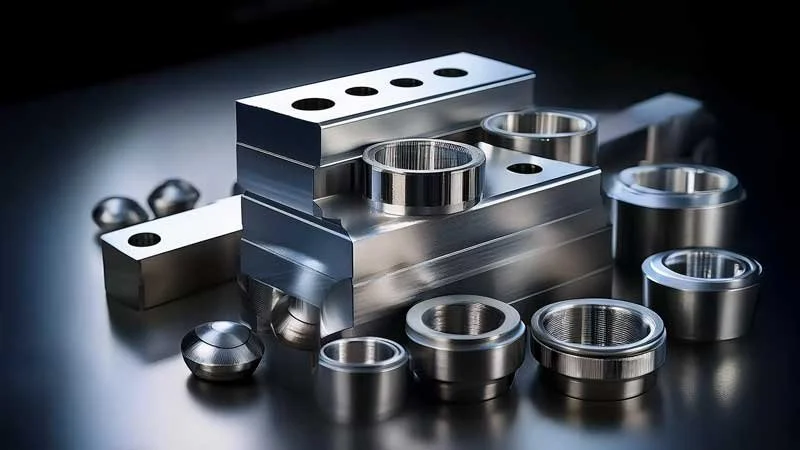
CNC fine-contour machining has become a defining capability in the production of multi-phase nickel alloy turbine chambers, where every micron of accuracy directly affects aircraft engine efficiency, thermal stability, and long-term structural integrity. Modern turbine chambers operate in some of the harshest engineering environments—exposed to rapid thermal cycling, extreme centrifugal forces, and aggressive oxidation conditions. To withstand these stresses, aerospace manufacturers rely on multi-phase nickel alloys such as Inconel 718, Rene 80, and Hastelloy X, materials engineered for exceptional heat resistance and fatigue strength. However, these alloys present formidable machining challenges because their multi-phase microstructures harden under heat, resist cutting abrasion, and exhibit unpredictable elasticity when subjected to tool pressure. As a result, fine-contour machining methods have evolved well beyond traditional subtractive techniques, incorporating multi-axis interpolation, adaptive toolpath refinement, micro-level surface control, and intelligent cutting parameter modulation. In SEO-driven aerospace content, search trends increasingly highlight precision nickel alloy machining, turbine chamber contouring, and heat-resistant material processing, reflecting the industry’s escalating focus on advanced CNC technologies that sustain engineering performance standards for next-generation aircraft engines.
Achieving fine-contour accuracy in multi-phase nickel alloy turbine chambers begins with understanding the unique interaction between tool geometry and the alloy’s microstructure. Nickel alloys tend to work-harden rapidly, causing cutting forces to spike and thermal loads to intensify as machining progresses. This behavior increases the likelihood of contour irregularities, dimensional drift, and surface burn if the toolpath is not carefully engineered. To address this, CNC machines now employ multi-axis contour-following algorithms that dynamically adapt tool angles and engagement depth to maintain smooth, consistent contact across curved interior surfaces. Unlike simple 3-axis cutting, fine-contour machining for turbine chambers leverages synchronized motion across up to five axes to trace organic curvature lines without faceting. This enables the creation of seamless chamber geometries that support optimized internal airflow, reduced turbulence, and improved combustion efficiency. Meanwhile, curvature-adaptive step-over strategies minimize tool pressure spikes, reducing the probability of micro-crack formation—a critical concern in heat-stressed chambers. As SEO data shows sustained interest in multi-axis turbine machining, adaptive cutting strategies, and nickel alloy precision contouring, the industry continues to prioritize methods that protect part performance through micron-level accuracy.
Specialized cutter technology enhances these contouring methods even further, especially in environments where heat dissipation and cutting stability are critical. Fine-contour machining often utilizes advanced tool geometries such as circle-segment cutters, variable-helix micro end mills, and multi-flute carbide tools engineered to withstand extreme temperatures. These cutters incorporate coatings such as AlTiN, TiSiN, and nano-diamond composites to combat the alloy’s abrasive tendencies while maintaining sharp cutting edges over extended machining cycles. In multi-phase alloys, tool engagement must remain consistent to prevent the cutter from digging into softer micro-phase regions or skipping across harder carbide sections. Thus, modern CAM systems simulate tool forces, temperature distribution, and anticipated wear zones before machining begins, ensuring predictable and uniform contour formation. High-pressure coolant delivery systems integrated directly into the spindle further enhance this stability by flushing chips away from narrow chamber cavities and dissipating heat quickly, preventing thermal distortions that could alter the chamber’s contour alignment. Rising SEO interest in cutter coatings, cryogenic nickel machining, and abrasive-resistant tooling indicates that engineers increasingly seek tooling-focused solutions to overcome the extreme demands of multi-phase nickel alloy machining.
Adaptive machining techniques represent one of the most transformative advances in CNC fine-contour processes for turbine chambers. Modern CNC platforms use real-time sensor data—capturing spindle load, vibration signatures, acoustic feedback, and thermal expansion metrics—to dynamically adjust machining parameters during cutting. This intelligence allows the machine to detect slight deviations in chamber curvature, material hardness, or tool deflection and immediately compensate by altering feed rate, spindle speed, tool tilt, or micro-stepover patterns. In multi-phase nickel alloys, where inconsistency in grain structure can cause unpredictable cutting responses, adaptive compensation ensures uniform surface integrity across the entire chamber. Advanced systems can even predict when a tool is about to fail, preventing catastrophic part damage and ensuring the continuity of fine-contour machining accuracy. With the industry increasingly adopting digital manufacturing frameworks, SEO queries related to AI-assisted machining, adaptive compensation technology, and real-time CNC surface control are becoming dominant—reflecting the shift toward intelligent, self-correcting machining ecosystems that deliver repeatable, high-quality turbine chamber components.
High-accuracy metrology plays an equally critical role in validating fine-contour machining results, particularly for components used in high-compression, high-temperature turbine assemblies. Modern turbine chambers require surface finishes with extremely low roughness values and contour tolerances measured in microns to ensure efficient fluid dynamics and structural reliability. Non-contact scanning technologies such as structured laser scanning, white-light interferometry, and high-resolution optical profilometry capture the full geometry of the chamber with exceptional detail. These systems detect surface waviness, contour deviations, micro-chatter marks, and form irregularities that may not be visible through traditional tactile inspection. Many aerospace manufacturers now integrate metrology directly into the CNC machining cell, allowing immediate verification and automatic toolpath correction without removing the part from its fixture. This closed-loop workflow significantly reduces scrap rates and ensures that fine-contour machining processes consistently meet AS9100 and NADCAP quality requirements. As SEO analytics continue to reveal rising interest in metrology-driven manufacturing, inline inspection workflows, and digital verification solutions, it is clear that precision measurement remains essential to the future of advanced turbine chamber machining.
Looking ahead, CNC fine-contour machining for multi-phase nickel alloy turbine chambers is positioned to advance through deeper digital integration, hybrid additive–subtractive workflows, and AI-driven machining optimization. Digital twin simulations allow engineers to model chamber airflow, thermal expansion, machining deformation, and tool deflection in a virtual environment before production begins. This predictive capability shortens development cycles and ensures that contouring strategies are optimized for both manufacturability and engine performance. Hybrid manufacturing is also reshaping turbine chamber production, combining additive processes that build near-net-shape components with subtractive fine-contour machining that delivers final precision. Machine learning algorithms are being trained on thousands of machining cycles to generate ideal cutting conditions for specific nickel alloy batches, improving consistency across high-volume production. As SEO interest grows in topics such as digital twin machining, hybrid turbine manufacturing, and predictive chamber optimization, manufacturers are leveraging these technologies to remain competitive in a rapidly evolving aerospace landscape. Ultimately, CNC fine-contour machining stands as a critical enabler of turbine chamber performance, ensuring that multi-phase nickel alloy structures deliver the strength, efficiency, and durability necessary for the next generation of high-performance engines.