
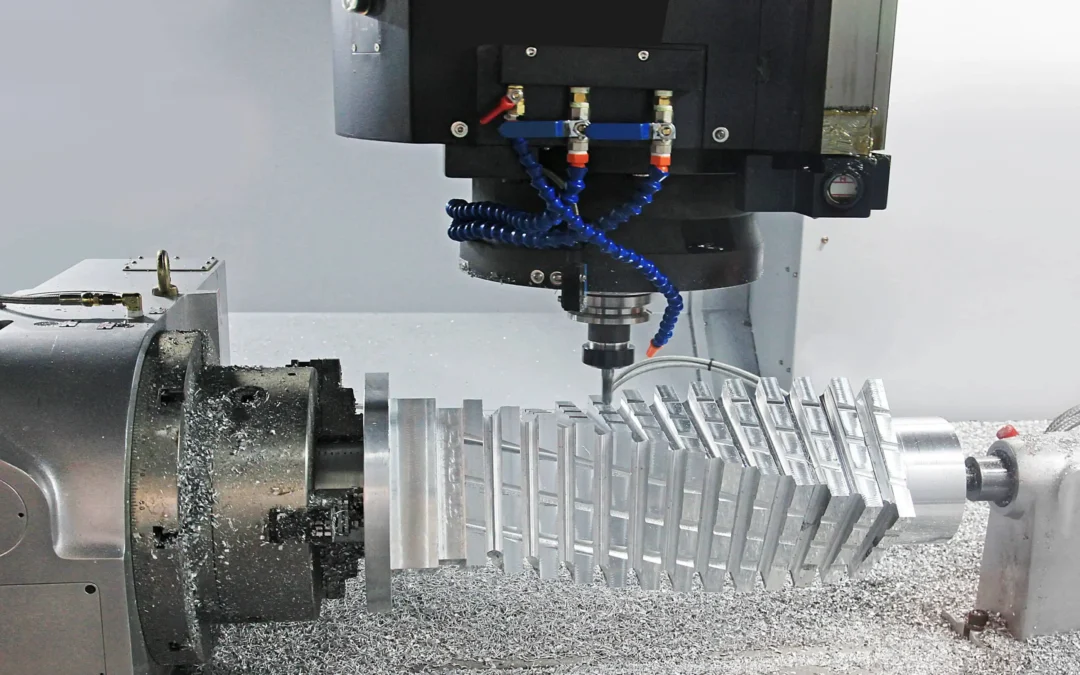
Precision CNC step-over optimization has become one of the most essential engineering strategies in modern compressor cavity profiling, especially as aerospace manufacturers transition toward tighter tolerance requirements, multi-material compressor assemblies, and increasingly complex curvature geometries. Deep cavity profiling presents a unique challenge because cutting tools must navigate continuously changing normal vectors, curvature intensities, and surface blends while maintaining uniform scallop height and consistent finish quality. This complexity means that traditional linear step-over planning or manual feed compensation approaches are no longer sufficient to achieve the repeatability, accuracy, and surface integrity required in high-performance compressor systems. Aerospace developers demand toolpaths that maintain micron-level conformity across deep curvature surfaces, especially in regions where aerodynamic flow and structural stiffness rely on highly precise cavity geometries. Modern CNC step-over optimization techniques provide an advanced, algorithm-driven approach that ensures tool engagement remains stable, chip load stays predictable, thermal gradients remain controlled, and tool deflection is minimized throughout the entire profiling cycle. By integrating advanced simulation, adaptive step-over modulation, and curvature-compensated cutting strategies, manufacturers are now able to produce compressor cavities that meet top-tier standards for fatigue life, aerodynamic efficiency, and surface microtexture uniformity.
In high-curvature compressor cavities, step-over optimization becomes the central mechanism that governs surface quality, machining time, and tool longevity. When the step-over is poorly calibrated, surface scallop height varies dramatically, resulting in waviness, micro-tearing, or undesired re-machining that can compromise both structural integrity and aerodynamic smoothness. With optimized step-over strategies, however, tool movement takes into account local curvature, material hardness variations, tool geometry changes, and directional loading on tool flutes. Instead of applying a fixed step-over measurement, next-generation algorithms adjust cutter engagement width dynamically along the toolpath. This method ensures that areas with steep curvature receive smaller step-over intervals for improved smoothness, while flatter regions can be machined using larger intervals to reduce machining cycle times without affecting quality. Computational models also account for radial tool deflection, cutter edge wear, and local heat buildup, allowing the CNC program to compensate in real time before deviations occur. As a result, the final cavity exhibits a remarkably consistent finish even at extreme depths, where tool accessibility, chip evacuation, and cooling efficiency are inherently more challenging. This is particularly important in high-efficiency compressor systems, where micro-scale surface disruptions can alter airflow stability, raise vibration signatures, or reduce the overall thermodynamic performance of the engine.
Advanced CNC step-over optimization also enhances the operational reliability and lifespan of cutting tools, which is essential when machining deep, high-pressure compressor cavities made from nickel-based superalloys or other heat-resistant aerospace materials. These materials often possess high tensile strength, low thermal conductivity, and significant abrasion potential, causing rapid tool wear if machining forces are not carefully controlled. By refining step-over values based on predicted force distribution and local chip load, manufacturers can minimize the development of wear facets, micro-chipping, and crater wear on tool cutting edges. This in turn supports a more stable machining environment, reducing the likelihood of unexpected tool breakage or surface gouging that may lead to costly part scrapping. Furthermore, step-over optimization helps maintain consistent heat levels within the cutting zone, reducing thermal distortion of the workpiece and preserving metallurgical integrity. This is especially critical in deep curvature cavities, where heat tends to accumulate due to limited coolant access. With step-over strategies that balance cutting load and heat dissipation, the overall machining process becomes far more predictable and sustainable, leading to higher throughput, lower operational costs, and improved quality assurance compliance across the production line.
From an aerodynamic and structural engineering perspective, the precision achieved through optimized step-over strategies directly impacts compressor durability and performance. In modern aero-engine designs, the internal cavities of compressor disks and casings are not merely structural features; they serve as aerodynamic flow channels, cooling passage boundaries, and load-bearing surfaces that operate under extreme thermal and mechanical conditions. Even small deviations in cavity geometry can influence airflow separation, vibration patterns, and structural fatigue rates. Step-over optimization ensures that cavity surfaces achieve the uniform microtexture necessary for reducing frictional drag and promoting stable boundary-layer behavior. It also helps maintain exact cavity dimensions crucial for achieving optimal airflow distribution within the compressor stages. By eliminating geometric inconsistencies, manufacturers reduce the likelihood of stress concentration points that could accelerate crack initiation or reduce disk lifespan. As aero-engine requirements continue to trend toward higher efficiency ratios and higher operating temperatures, the demand for flawless cavity geometry becomes more pronounced. CNC step-over optimization provides the level of control required to meet these evolving standards without extensive manual finishing or post-processing steps.
The final advantage of advanced CNC step-over optimization lies in its adaptability to digital manufacturing ecosystems, simulation-driven machining workflows, and automated quality assurance systems. With modern CAM platforms, step-over optimization can be combined with digital twins, real-time feedback loops, and automated in-process metrology to produce a fully integrated machining strategy. These systems analyze predicted forces, tool engagement conditions, geometric curvature, and heat profiles to generate step-over parameters that maximize machining performance while ensuring compliance with engineering specifications. Machine learning algorithms can further refine step-over patterns based on historical machining data, identifying patterns such as wear progression, tool deflection tendencies, or material response behaviors unique to specific alloys. This creates a cycle of continuous optimization that improves with every production batch, enhancing long-term efficiency and consistency. Additionally, integrating step-over optimization with high-resolution scanning and automated surface inspection allows manufacturers to verify cavity conformity with unprecedented accuracy, reducing the need for manual inspection or rework. As aerospace component production becomes more automated, this integrated approach ensures that deep curvature compressor cavities are machined to the highest precision standards while maintaining efficiency and reducing overall operating costs.
Through its combination of dynamic toolpath modulation, fatigue-reducing surface quality, improved tool life, and seamless integration with digital manufacturing systems, CNC precision step-over optimization has emerged as a cornerstone of advanced compressor cavity profiling. Modern aerospace applications demand machining strategies that can maintain extreme accuracy in deep geometric structures while controlling thermal, mechanical, and dynamic variables that influence tool and workpiece performance. By applying advanced step-over techniques, manufacturers are able to consistently deliver compressor cavities that meet the rigorous standards of next-generation turbine engines. This results in improved aerodynamic performance, enhanced structural integrity, and longer service life across compressor components. As aerospace technology continues to evolve, the role of precision CNC step-over optimization will only grow more critical, solidifying its place as a foundational technique for high-performance compressor cavity engineering.