
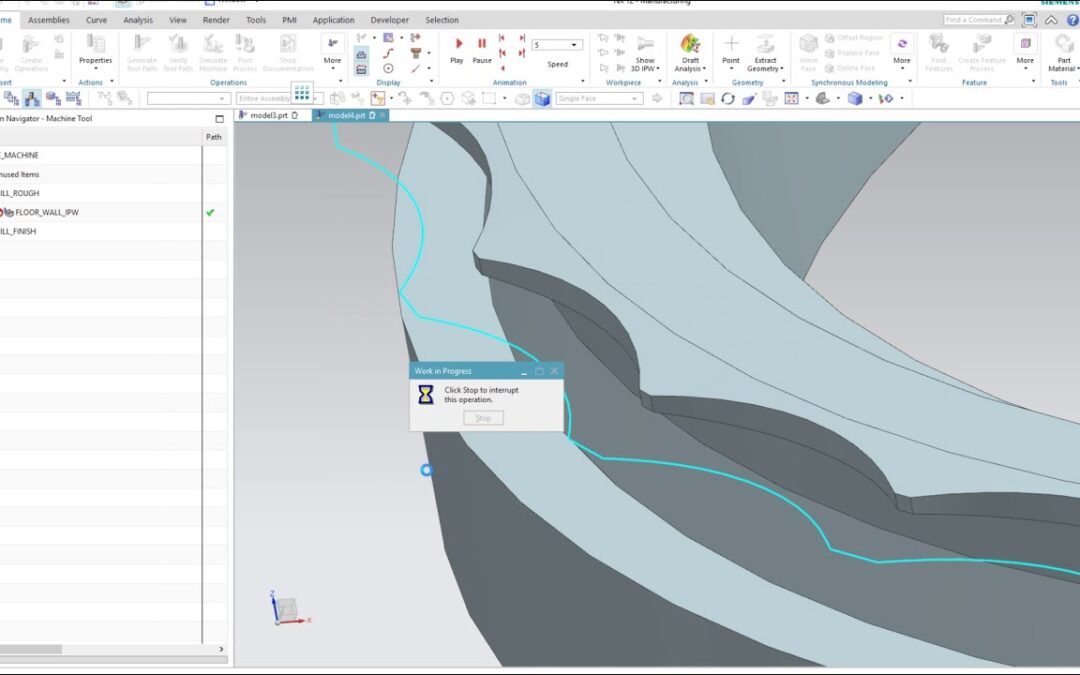
Advanced CNC scallop reduction has become a critical focus in modern aero-engine manufacturing, especially as turbine and compressor cavity geometries continue to evolve toward more organic curvature profiles and ultra-tight tolerance allowances. In high-performance aero-engine platforms, even microscopic surface deviations inside cavity walls can disrupt airflow, increase thermal loading, and weaken structural reliability under extreme rotational stress. Scallops—the small ridges or stepping patterns created by toolpath overlap during multi-axis machining—pose one of the most persistent challenges in producing smooth cavity interiors, particularly when those cavities incorporate deep contours, double-curved surfaces, and compound radii. As OEMs tighten requirements for surface integrity, scallop reduction has shifted from a simple machining refinement to a highly engineered strategy involving advanced cutter geometry, adaptive multi-axis interpolation, high-resolution toolpath optimization, and real-time surface compensation. Within SEO-focused aerospace manufacturing content, searches related to scallop minimization, cavity wall finishing, and advanced CNC accuracy continue to rise, reflecting growing industry demand for precision-engineered surface refinement methods.
The science of scallop formation and reduction in curved aero-engine cavities begins with understanding surface topology and tool engagement behavior. Unlike flat or mildly curved surfaces, aero-engine cavities often contain extreme curvature shifts that challenge traditional 3-axis and even some 5-axis machining methods. Variations in surface slope cause inconsistent stepovers, resulting in scallop height fluctuations unless the toolpath is dynamically adapted in real time. For this reason, high-end CNC systems now incorporate curvature-driven toolpath planning algorithms capable of modulating tool engagement angles, feed rates, and stepover distances based on the local curvature of the cavity wall. This ensures that scallop height remains consistent even as the tool navigates complex contours. Additionally, modern CAM software employs iso-scallop, adaptive constant scallop, and flowline toolpath patterns that align cutter motion with the natural geometry of airflow channels inside the cavity. These methods reduce perpendicular tool marks, create smoother transition zones, and improve aerodynamic surface behavior. In SEO contexts, terms such as constant scallop machining, curvature-adaptive toolpaths, and advanced cavity surface optimization rank prominently across aerospace engineering searches.
Tooling technology also plays a decisive role in scallop reduction, especially when machining heat-resistant alloys like Inconel, Hastelloy, Rene-series superalloys, and titanium used widely in aero-engine cavity construction. Traditional ball-nose end mills often produce scallops due to their small effective cutting radius at shallow contact angles. To address this, manufacturers now deploy high-performance cutter designs such as taper-barrel cutters, lens-shaped end mills, oval-form tools, and advanced circle-segment cutters. These tools significantly enlarge the cutter’s effective radius, allowing each machining pass to cover a wider surface region and drastically reduce scallop formation. Their geometry also enhances contact stability, minimizes vibration, and generates ultra-smooth surface finishes with fewer tool passes—an advantage that reduces machining time without sacrificing quality. Cutter coatings such as TiSiN, AlTiN, and nano-composite diamond variants further improve thermal resistance and edge longevity, enabling stable scallop-reducing performance across long machining cycles. Growing SEO interest in circle-segment cutters, high-accuracy tool geometry, and aerospace superalloy finishing indicates that engineers increasingly seek tooling-centric scallop reduction solutions.
Real-time adaptive control has become one of the most transformative advancements in scallop reduction for curved cavity walls. High-accuracy CNC machines equipped with thermal compensation, spindle vibration monitoring, and AI-powered error-correction systems can dynamically adjust toolpath parameters as machining progresses. These systems detect micro-level variations in tool deflection, cutting forces, and part temperature—factors that would otherwise introduce inconsistent scallop patterns or unpredictable surface waviness. By recalculating tool angle, feed modulation, and stepover on-the-fly, adaptive CNC systems maintain uniform surface textures even on areas with steep concave curvature, deep recessed pockets, or narrow cavity sections. Additionally, acoustic emission sensors and high-frequency load cells provide real-time diagnostics that help predict surface finish deviations before they occur. This new era of intelligent machining aligns strongly with SEO trends centered around adaptive CNC compensation, AI-driven machining strategies, and precision aerospace cavity finishing. As manufacturers transition to digitally optimized workflows, the integration of adaptive scallop control is increasingly seen as a competitive necessity.
The role of surface finishing and post-machining refinement cannot be overlooked in advanced scallop reduction strategies. Even with highly optimized toolpaths and cutter geometry, some cavities—particularly those with extremely complex curvature—may still exhibit minimal residual scallops that require additional smoothing. Processes such as robotic abrasive flow machining, non-contact laser polishing, micro-abrasive slurry finishing, and diamond-brush adaptive contour finishing provide further refinement by smoothing microscopic tool marks while preserving geometric integrity. These finishing methods are particularly valuable in cooling cavities, bleed-air passages, and aerodynamic wall surfaces that demand near-mirror micro-finish levels to enhance thermal exchange efficiency and airflow stability. Modern finishing systems can also integrate with digital cavity scans to selectively polish only the regions requiring additional smoothing, maximizing efficiency. As SEO analytics show rising interest in automated cavity finishing, hybrid CNC + finishing workflows, and precision micro-polishing methods, it’s clear that post-machining strategies are now essential components of scallop reduction in advanced aerospace manufacturing.
Looking ahead, the future of CNC scallop reduction for curved aero-engine cavity walls is moving rapidly toward a fully predictive, data-driven, and simulation-enhanced manufacturing ecosystem. Digital twins now allow engineers to simulate machining outcomes—including predicted scallop heights, thermal behavior, and final surface textures—before the cutter ever touches the material. When paired with automated metrology, digital twins can continuously refine machining parameters across multiple production cycles, creating a closed-loop learning environment where scallop formation is minimized automatically over time. Meanwhile, hybrid manufacturing approaches that combine additive processes with subtractive spiral finishing allow cavities to be built closer to final geometry, reducing the material removal required and minimizing scallop-prone tool engagement regions. As aerospace companies strive for lighter, hotter, and more fuel-efficient engines, the precision of cavity surface quality will only become more important. For SEO-driven visibility, incorporating topics such as next-generation scallop reduction, digital twin machining accuracy, and hybrid aero-engine cavity manufacturing aligns strongly with current industry search patterns. Ultimately, advanced CNC scallop reduction techniques represent more than surface refinement—they are essential contributors to engine durability, thermal efficiency, and overall aerospace performance, ensuring that complex curved cavity walls perform flawlessly under the most demanding flight conditions.